The Monolithic Bottleneck
What's in this lesson: How modern ecosystems abstract functionality into reusable skills, dynamic capabilities, and automated workflows.
Why this matters: As agents grow in complexity, they need standardized building blocks to collaborate efficiently and scale beyond hardcoded scripts.
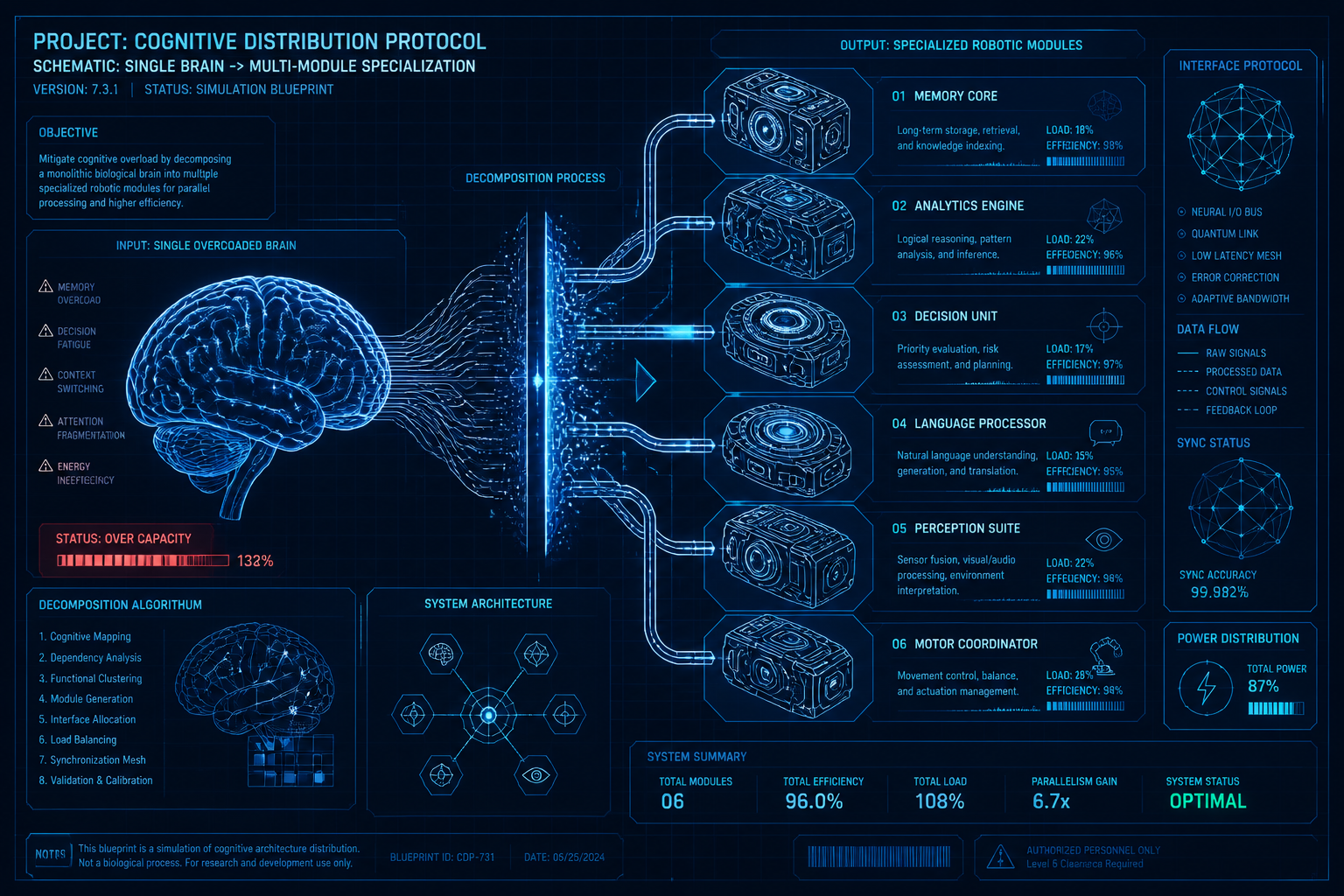
A single, monolithic "do-everything" agent prompt is brittle and impossible to scale. Modern AI architectures instead separate capabilities into discrete, modular skills that can be chained together dynamically.
You are an agent that writes code, tests code, deploys code, handles customer support, and manages databases... (Error: Context Limit Exceeded / Instruction Drift)
Defining Skills vs Capabilities
In agent design, we separate the concept of an action from its implementation.
- Capability: A semantic description of what an agent can achieve (e.g., "Can Read PDFs").
- Skill: The actual executable code and tool logic that performs the task (e.g., "PyPDF2 Extraction Script v1.4").
Capability (The "What")
Used by the Router to decide if an agent is qualified.
{"type": "vision", "desc": "Process images"}
Skill (The "How")
Used by the Agent to actually perform the work.
import cv2; def read_img(): ...
Tool-to-Skill Abstraction
Providing an LLM with a raw API endpoint is risky. The model has to guess the exact JSON schema and handle HTTP errors. Tool-to-Skill abstraction wraps the raw API in a layer of reasoning, error handling, and formatting.
This means the agent simply says "Search for X", and the Skill handles the API keys, retries, and data parsing.
// Raw API expects perfect schema from LLM
{
  "endpoint": "https://api.github.com/repos/...",
  "headers": {"Authorization": "Bearer ..."},
  "body": {"query": "repo:microsoft/autogen"}
} // If LLM misses a quote, it breaks.
Shared Skill Libraries
Instead of rewriting the "Web Search" code for every new agent, developers maintain Shared Skill Libraries.
Agents import these skills at runtime. This enforces consistency, allows centralized security audits, and lets multiple agents share the exact same capability logic.
Assign a skill from the central library to both agents:
Skills:
[None Selected]
Skills:
[None Selected]
Knowledge Check
What is the primary advantage of a tool-to-skill abstraction over raw API tool calling?
Skill Registration & Discovery
In highly dynamic ecosystems, an agent might encounter a task it doesn't know how to solve natively. It can query a Skill Registry at runtime to discover new capabilities.
The registry maps semantic needs (e.g., "I need to parse an Excel file") to registered skill endpoints.
Needs: Excel Parser
Capability Routing

Once skills are registered, an orchestrator must route user intents to the correct agent or skill.
- Deterministic (Intent) Routing: Uses fast, predefined rules (like regex or classifiers) to map specific requests directly to skills. High speed, low cost.
- LLM-Based Routing: The language model analyzes the prompt and decides dynamically which tool to use. Highly flexible, but slower and more expensive.
Select Routing Strategy:
Select a strategy to see its characteristics.
Knowledge Check
In capability routing, why might deterministic (rule-based) intent routing be preferred over LLM-based routing?
Workflow Composition: Static vs Dynamic
How do we connect these agents and skills together?
Static Workflows (DAGs): The sequence of steps is hardcoded in advance. Great for rigid pipelines (e.g., ETL jobs) but cannot adapt to unexpected data.
Dynamic State Machines: Execution flows through nodes based on intermediate states and conditions. Agents can loop back to fix errors or skip steps dynamically.
Dynamic Workflow Assembly
In advanced setups, an Orchestrator Agent dynamically assembles the workflow at runtime. It analyzes the user request, breaks it into subtasks, and assigns them to specialized agents on the fly.
Cross-Agent Capability Sharing

When tasks are delegated, agents must pass state and context effectively. Cross-agent capability sharing allows Agent A to finish its specific skill execution and directly hand the resulting data payload over to Agent B, maintaining the overall state of the workflow.
Knowledge Check
Which of the following best describes "Dynamic Workflow Assembly"?
Ecosystems in Action
Modern frameworks implement these concepts to varying degrees:
- LangGraph: Focuses heavily on state machines and cyclic workflows. It excels at defining clear boundaries where agents share state explicitly via a central graph structure.
- AutoGen (Microsoft): Focuses on conversational multi-agent routing. Agents "talk" to each other to negotiate task delegation and capability usage seamlessly.
Both architectures rely fundamentally on abstracting tools into reliable skills, and routing intents to the correct capability.
Summary & Key Takeaways
Before moving to the assessment, review the core concepts of agent ecosystems:
Module Assessment
You have completed the tutorial pages. It's time to test your knowledge on Skills, Capabilities, and Agent Workflows.
This assessment contains 5 questions. You must score at least 80% to earn your certificate.
Question 1 of 5
What is the primary advantage of a tool-to-skill abstraction over raw API tool calling?
Question 2 of 5
In capability routing, why might deterministic (rule-based) intent routing be preferred over LLM-based routing?
Question 3 of 5
Which of the following best describes "Dynamic Workflow Assembly"?
Question 4 of 5
What role does a "Skill Registry" play in an agent ecosystem?
Question 5 of 5
When multiple specialized agents collaborate, what does "Cross-Agent Capability Sharing" enable?